How to Follow Up With Real Estate Leads Who Aren't Ready Yet

You are scrolling the new closings on a Tuesday night and a name stops you. You met them at an open house in March, they told you probably next year, and you wrote their number down and meant every word of the promise to stay in touch. The sticky note with that number on it is still on the edge of your monitor.
They bought. Somebody else sold them the house.
Not ready is not the same as not yours
Most agents treat a lead who says "not yet" as a lead who said no. The conversation ends politely, the name goes somewhere, and the agent goes back to the people who want to see houses this weekend. That feels like good prioritization, and half of it is.
Working the ready people first is correct. Letting everyone else drift is the expensive part, because the not-ready lead has a real estate need on a date. They just have not told you the date, and nobody is going to remind them who you are when it arrives.
I say this to agents in some form most weeks: this person could have a real estate need in the next six months and forget about you. It will not be because you did anything wrong; you did nothing, and somebody else did one thing. The agent who sold that house to your open house couple was probably no better than you, just the one who called in the month it mattered.
Your memory is not a pipeline
Ask an agent where their future business lives and you get a tour. Some of it is in the phone, some is in a notebook in the car, some is on sticky notes, and the rest lives in their head.
The head version always feels complete. You can recite the names when somebody asks. What you cannot do is see all of them at once, sorted by who needs you first, on a morning when you are tired and three other things are on fire. A list you have to reconstruct every time you use it is a list you will stop using.
The notebook people have a different problem. They are usually the best relationship builders in the room, out every day, meeting people and finding real estate needs, and then the names go into a notebook and never come out. A notebook gets left in the car or caught in a fire, and it will never tell you on Thursday that you promised somebody a call in October. Most of the agents I coach are not short on leads at all; they are short on a place where the leads can be seen.
The list is names sorted by when, and that is all
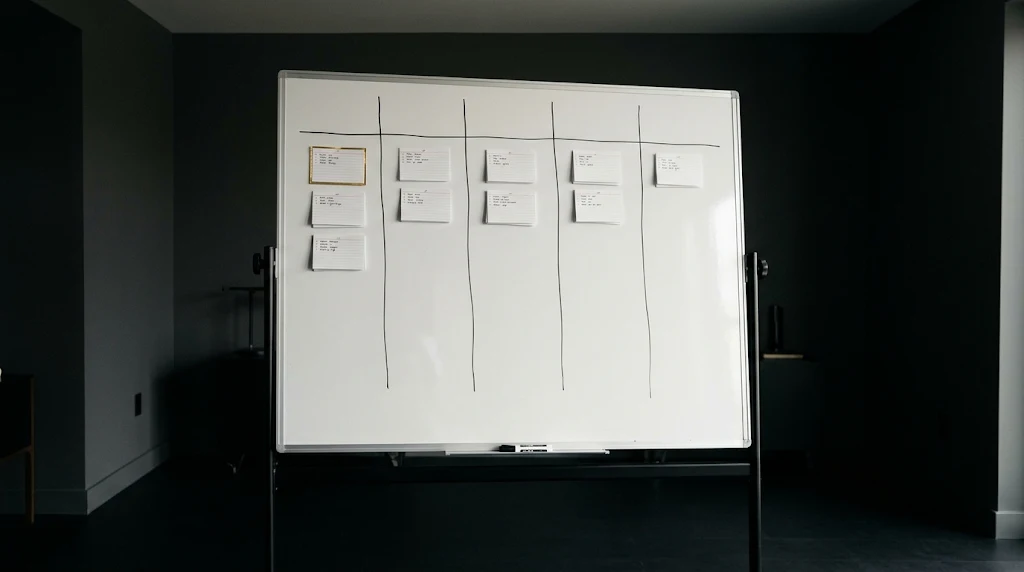
The whole system is smaller than people expect. Just people's names organized by their timeline so you know who to follow up with: now, this spring, this summer, next year, unknown.
Motivation looks like something you have to read off a person's face. It is always tied to a timeline. A lease ends, a kid starts school, a job moves, a house gets too small, and the moment you know the when, you know where the name goes on the list.
If you do not know the when, that is the follow-up call. "Last time we talked you said probably next year. Is that still the plan, or has anything changed?" One question, and the name moves to the right column.
The format does not matter nearly as much as agents want it to. A whiteboard works, a spreadsheet works, and so does photographing the notebook page at the end of the day and having it typed into one list. I want you to have a clear view of your pipeline, but in a way you are actually going to use. The best system is the one you look at every day, and almost nobody looks at a CRM every day.
I hate CRMs, and that is the most dangerous thing I say

I hate CRMs. I think they are all terrible, which is an awkward thing for a guy who builds software for agents to say on the record. When I built my own tool, I took the pipeline view out of it and kept a number and a scoreboard. Behind my computer screens there is a whiteboard so big it sits on a flip stand so I can use both sides.
That opinion is real, and it is also the easiest thing in this post to misuse. An agent hears that the coach hates CRMs and files it as permission: the sticky notes are fine, the head is fine, structure is for other people. I say the first half of my position much louder than the second half, and the second half is the one that does the work.
So here is the second half, said plainly. You do not need a CRM to tell you what to do, but you do need one list, sorted by when, that you look at every working day. The habit of looking is the asset, and what matters is what you do with the information once you see it.
Follow-up gets its own block, and the block survives a bad day
A list nobody works is a nicer-looking notebook. So the list gets a standing appointment, an hour a day at the same time.
The order matters. You follow up with the highest priority leads during your follow-up block, the people closest to their date. When the follow-up block is done, you go on appointments, and the later timelines get worked on a set day each week so they never fall off entirely.
Then comes the day the block gets wrecked. A listing appointment moves, an inspection goes sideways, the paperwork eats the morning. Most agents look at their hour, see that fifteen minutes are left, and decide fifteen minutes is not worth starting.
James Clear has a phrase for the alternative: reduce the scope, stick to the schedule. In follow-up terms, you do not have an hour to call ten people. You do have fifteen minutes to text three people from the top of the list, and because the list is already sorted, picking them takes a minute. Do it small so it still gets done.
Count the block by what it produces, not by how busy it felt: conversations, then appointments set, then appointments held, then signed clients. The agents who keep a pipeline full are the ones whose worst week still had a follow-up block in it.
Your newsletter is not follow-up

The other place agents hide is automation. The monthly email goes out, the calendar magnet goes in the mail, the market update lands on schedule, and it feels like staying in touch.
It is not their job to remember you just because you send them a newsletter or a calendar magnet. The mailer is fine as background, but the not-ready lead becomes a ready lead in a conversation, usually one where somebody asked them a question at the right time.
Automation also gives you a false sense of coverage. Everyone is technically being touched, so nobody feels neglected on paper. Then a past client lists with somebody else and you realize the last time you actually spoke to them was nine mailers ago, which is why the automation can stay but should never be counted on the list.
A real touch does not need a reason dressed up as market news. Ask what has changed since you last spoke, ask whether the timeline still holds, and listen for the date. If it moved closer, the name moves columns. If it moved further out, you still learned something nobody on the mailing list learned, and the next call has a starting point instead of an excuse to skip it.
Forty-five minutes now saves the lead you would lose in March
This takes about forty-five minutes once, then the hour a day you already owe your business.
Build the list by when. Pull every name from your phone, your notebook, your sticky notes and your head into one place, sorted into now, this spring, this summer, next year and unknown. Unknown is not a dead column; it is tomorrow's call list.
Put the follow-up block on your calendar and decide its small version now. Pick the hour it happens every working day, and decide in advance what it shrinks to on a bad day: fifteen minutes and three texts from the top of the list. A small version you chose this week is a plan, and one you invent while the day is falling apart is a negotiation you will lose.
Ask one question at the start of every block. Who on this list is closest to their date and has not heard from me? Answer it from the list, not from memory, and call that person first.
Then take the sticky note off the monitor. Write the name on the list, in the right column, with the month next to it.
The next time that name shows up on a Tuesday night, it should be because you are the one who sold them the house.
Sources
James Clear, article at jamesclear.com/plan-for-chaos, source of the phrase "reduce the scope, stick to the schedule."